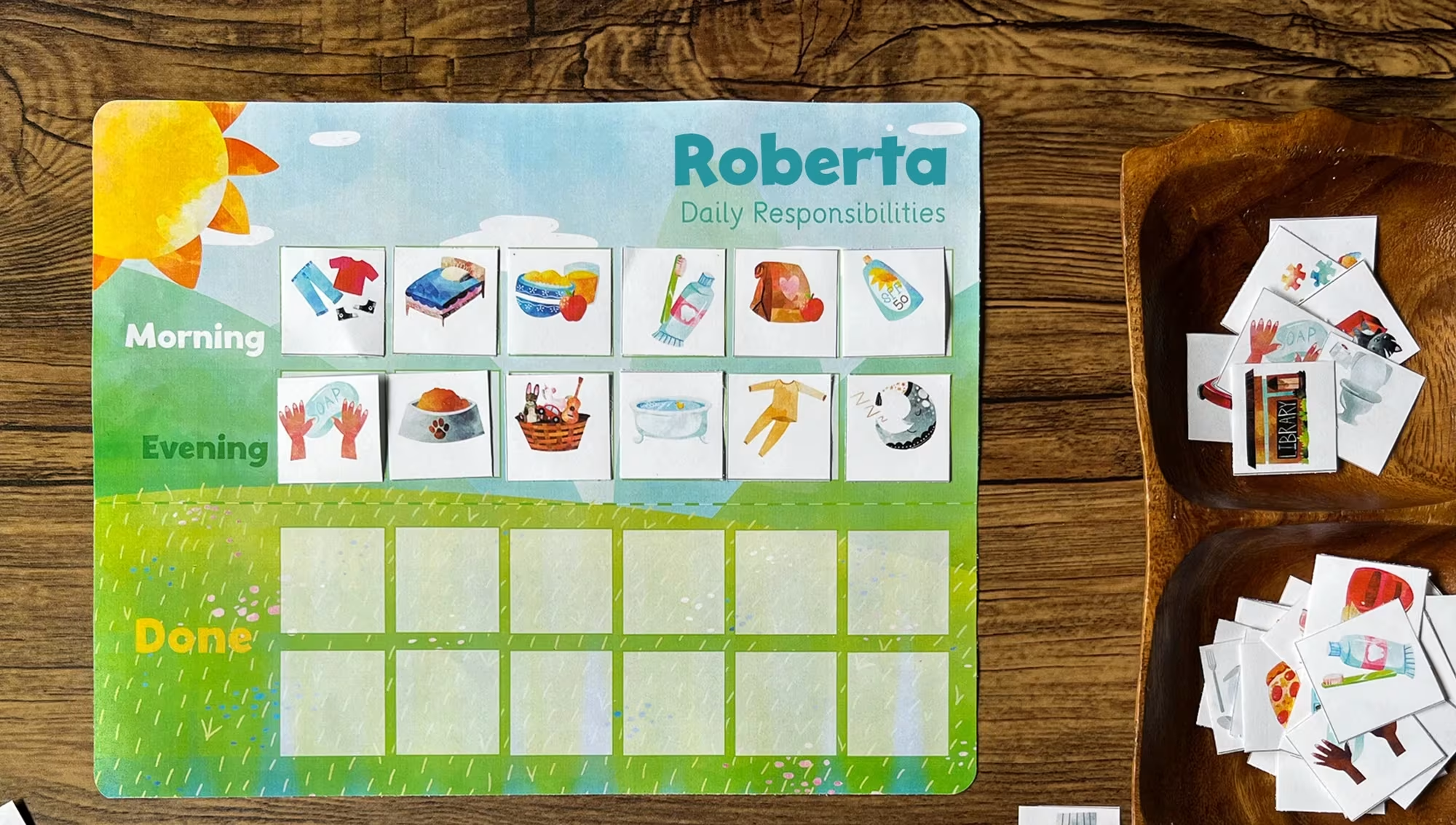
TL;DR
- The “Harvard study on chores” all over Instagram isn’t really a Harvard study about chores. The real longitudinal data comes from the University of Minnesota.
- Dr. Marty Rossmann followed 84 kids from preschool into their mid-20s. The strongest predictor of adult success in the dataset was whether they started household tasks at ages 3–4. Not 8. Not 10. Three.
- A 2014 Braun Research survey of 1,001 adults: 82% had regular chores growing up, only 28% require their own kids to do them. I’m in the 72%. Cleanly. No defense.
- Mechanism is executive function — working memory, impulse control, sequential planning. The exact stuff that makes someone good at school, work, and not losing their keys. I had not connected those dots.
11pm. Tea, lukewarm by the second paragraph. I went looking for a quick parenting tip — something practical, something I could just do tomorrow — and instead I ended up forty minutes into a chain of citations from blog posts that all linked to other blog posts.
The phrase that kept showing up: “Harvard’s 85-year study found that childhood chores are the biggest predictor of adult success.”
I had seen this everywhere. I’d probably nodded at it on Instagram without thinking too hard. It has that satisfying shape of a thing you already kind of believe — chores, discipline, character — wrapped in the institutional authority of the word Harvard.
So I went to find the study.
Reader: it doesn’t quite exist.
i mean. the harvard study exists. just not the part everyone keeps citing.
Quick fork in the road, because this post does two things at once. If you just want the useful part — what kids can actually do at each age, and the one thing the research says not to do — skip straight to it ↓. If you want to come down the rabbit hole with me first, keep reading.
Here’s what I pieced together after enough clicks to lose track of how I got there.
The Harvard Grant Study is real. It started in 1938, it’s been running ever since, and it’s genuinely found that adult happiness and success come down to two things — love and work ethic. That part holds up.
The thing it didn’t directly study is chores.
The chores framing came from Julie Lythcott-Haims, former Dean of Freshmen at Stanford, in a 2016 TED Talk about over-parenting. She cited the Grant Study as context for the broader point — work ethic matters, here’s a building block for it. From there it got compressed by approximately a thousand blog posts into “Harvard study proves chores predict success,” which is not what anyone exactly said.
So that’s the meme. The actual chores research is real — it just came from Minnesota.
Dr. Marty Rossmann, emeritus professor of family education at the University of Minnesota, published a paper in 2002 analyzing data from 84 children followed across four stages of their lives: preschool, around 10, around 15, and into their mid-20s. The question she asked was direct: does involving kids in household tasks early actually predict anything about who they become?
It did. And not weakly.
The young adults who had started doing household tasks at ages 3–4 were more likely to have strong relationships, achieve academic and career success, and be self-sufficient — compared to kids who started chores later, or not at all. Starting at 3–4 was the single strongest predictor in the dataset.
Three to four years old.
"The best predictor of young adults’ success in their mid-20s was that they participated in household tasks when they were three or four."
— Rossmann, 2002, via University of Minnesota ExtensionI keep coming back to that age. Three. Three is the age at which a child can definitely make a mess on the floor and definitely not yet operate a vacuum. Three is the age I would normally describe as “still small.” Apparently three is also the age at which the developmental window for this stuff is wide open and we are mostly walking past it carrying snacks.
The other finding I want to flag — because nobody seems to repeat this part — is what happened when kids started chores later. Around 9 or 10, the effect weakened significantly. Around 15, weaker still. By that age, she observed, kids tended to experience the request as something being done to them rather than something they were genuinely part of. The “we’re all in this together” framing hadn’t taken root. So the window isn’t just “start them young.” It’s “start them young or it gets harder.”
While I was deep in the rabbit hole I hit this one, from a 2014 Braun Research survey of 1,001 U.S. adults:
82% had regular chores growing up. 28% require their own children to do them.
I read it twice. Then I read it three more times to see if I was misreading it.
That’s a 54-point swing in one generation. We didn’t quietly debate this and decide chores were harmful. We just… let it slide. Because doing the dish ourselves is genuinely faster than walking a small human through how to scrape the plate. Because by 6:30pm we’re tired and the math of “spend 20 minutes teaching this OR spend 4 minutes doing it” only goes one way when you’re running on coffee fumes.
I am, transparently, in the 72%. I will not pretend otherwise. It’s not from a thought-out parenting philosophy. It’s from accumulated small Tuesdays where it was 9pm and I just wanted the kitchen done and going to bed felt closer than building character.
“it’s faster if i do it” turns out to be the foundational sentence of a parenting style i didn’t realize i had adopted.
(Land here from the top? Good. No story attached — just the part you can use.)
The short version: the research (Rossmann, University of Minnesota) found that kids who started household tasks at 3–4 did better in their mid-20s than kids who started later. Here’s the age-by-age of what that actually looks like — because I’m pretty sure most of us are calibrated low. I know I was.
| Age | What they can genuinely manage |
|---|---|
| 3–4 | Toy cleanup, carrying lightweight items, wiping spills they made |
| 5–6 | Making their bed, setting the table, feeding a pet |
| 7–8 | Loading the dishwasher, basic meal prep, taking out trash |
| 9–12 | Full laundry cycles, meal planning help, yard work |
Look at the 3–4 row. None of that is dangerous. None of that requires fine motor skills they don’t have. None of that requires reading. A three-year-old can put toys in a bin. A four-year-old can wipe a spill. We know this — we’ve watched them do it — and we still tend to swoop in and finish the job because the finish is bad.
The finish is supposed to be bad. That’s not a bug.
One more thing the research is specific about, and I want to write it down because I would absolutely default to it otherwise: using chores as punishment doesn’t work, and actually backfires. It builds a negative association with contributing that’s hard to undo later. The framing has to be participation, not consequence. Which means I also have to participate visibly. Not just assign and walk off.
I’m not going to wrap this up with a clean “and now everything is different in my house.” That would be a lie and you’d smell it.
What’s actually changing is smaller: I’m noticing the reflex now. The “I’ll just do it” moment. I’m catching it maybe one time out of three. The other two I still do the thing because I’m tired and it’s late and I haven’t built the new habit yet.
But the research isn’t asking for a transformation. It’s asking for consistency — even imperfect consistency, early. A kid who clears their plate badly every night beats a kid who clears it perfectly once a quarter. That math, weirdly, makes me feel better about the whole thing. I don’t have to be good at this immediately. I just have to not skip it.
The honest version is: I’ll probably forget. I’ll have weeks where I default back to doing everything myself because Tuesday is Tuesday. But now I know what I’m trading away when I do that, and “it’s faster” doesn’t feel like a free choice anymore.
That’ll have to be enough for now.
A note on sources: I’ve linked the Rossmann study PDF and the Braun Research coverage directly above. The “Harvard study on chores” framing I’d seen everywhere turned out to trace back to a TED Talk interpretation rather than a direct finding — if you want to follow that thread yourself, this breakdown does a good job of untangling it. I’d rather flag the complication than let it sit quietly in the post.
Key takeaways
- The Rossmann study (U of Minnesota, 2002) is the one with direct longitudinal data on chores and adult success. 84 kids, four stages, 25-ish years.
- Starting at 3–4 matters more than most of us think. Later start = significantly weaker effect.
- The 28% / 82% gap isn’t a research debate. It’s the daily friction of letting kids do things slower and worse than we could.
- Chores as punishment specifically undermines the goal. Framing has to be “we’re all in this together,” including the adults.
- The hardest part isn’t assigning the task. It’s not jumping in when they’re doing it badly.